---
theme: seriph
title: "Lesson 08 — How Can an Agent Know What It Needs to Learn?"
info: "English video course for AI Agents in Depth"
author: Bojie Li
transition: slide-left
mdc: true
lineNumbers: false
monaco: false
aspectRatio: 16/9
canvasWidth: 980
layout: cover
class: cover
---
Build · Chapter 2 · Context Engineering
# How Can an Agent Know What It Needs to Learn?
Skills, progressive disclosure, and on-demand capability
Lesson 08 of 42 · 18 minutes · Dynamic Prompts and Agent Skills; Skills and Tools
---
layout: center
class: text-center
---
The central question
How can an Agent access hundreds of specialist procedures without carrying all of them in every prompt?
---
# Why this problem matters
Discovery
A thin index tells the Agent what knowledge exists.
Disclosure
Detailed instructions load only after a relevant trigger.
Execution
Bundled scripts make repeated procedures deterministic.
---
# Three ideas to keep in view
Skill metadata
Name and description stay visible
Skill body
Workflow loads only when selected
Resources
References and scripts load only when required
---
# The book's visual model

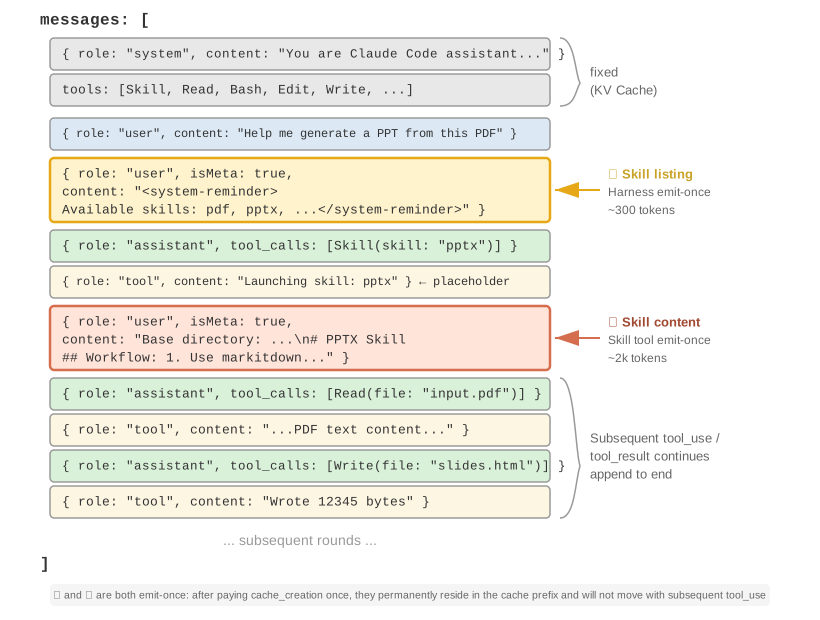
Skills progressive disclosure
---
# Everything preloaded vs. Progressive disclosure
Everything preloaded
- Large static prompt
- High information competition
- Every task pays the cost
Progressive disclosure
- Thin capability index
- On-demand instructions
- Task-specific context
Skills trade metacognition risk for context efficiency.
---
# A Skill is a navigable package
~~~text
pptx/
├── SKILL.md # when and how
├── reference.md # details on demand
├── scripts/
│ └── render.py
└── templates/
~~~
---
# Test the claim
2-63 min
Generate a deck through progressive Skill loading
Observe: Metadata → Skill body → referenced script → verified artifact
Demo budget: 3 minutes · one contiguous terminal block
---
class: course-terminal
---
Live demo
# Switching to the terminal
~~~bash
$ uv run python chapter2/agent-skills-ppt/demo.py --offline
~~~
Run the command(s), narrate decisions, and point to the observation—not just the output.
---
# What the evidence supports
Finding 1
The Agent initially sees a capability index rather than full instructions.
Finding 2
File reads turn specialist knowledge into explicit trajectory events.
Finding 3
Scripts reduce token use and make artifact creation testable.
---
layout: center
---
Where the claim stops
# Boundary condition
Progressive disclosure fails when the model does not recognize that a Skill is relevant.
---
layout: center
---
Engineering takeaway
# Design rule
Keep capability descriptions broad enough for discovery and Skill bodies narrow enough for reliable execution.
---
# Continue the experiment
---
layout: center
class: text-center
---
Pause and apply
# Your turn
How would you measure false-negative Skill discovery?
---
layout: center
class: text-center
---
Next · Lesson 09
Long tasks need explicit state and selective forgetting, not only selective loading.
→