---
theme: seriph
title: "Lesson 40 — Who Should Coordinate Independent Agents?"
info: "English video course for AI Agents in Depth"
author: Bojie Li
transition: slide-left
mdc: true
lineNumbers: false
monaco: false
aspectRatio: 16/9
canvasWidth: 980
layout: cover
class: cover
---
Expand · Chapter 10 · Multi-Agent Collaboration
# Who Should Coordinate Independent Agents?
Peer review, managers, decentralized handoffs, files, and control planes
Lesson 40 of 42 · 17 minutes · Non-Shared Context; File System; Communication and Control; Collaboration Topologies; A2A
---
layout: center
class: text-center
---
The central question
When Agents work in separate contexts, what structure keeps their work coherent?
---
# Why this problem matters
Peer loop
A proposer and reviewer iterate with independent evidence.
Manager
One planner decomposes, budgets, schedules, and integrates.
Decentralized
Peers transfer work without a runtime central controller.
---
# Three ideas to keep in view
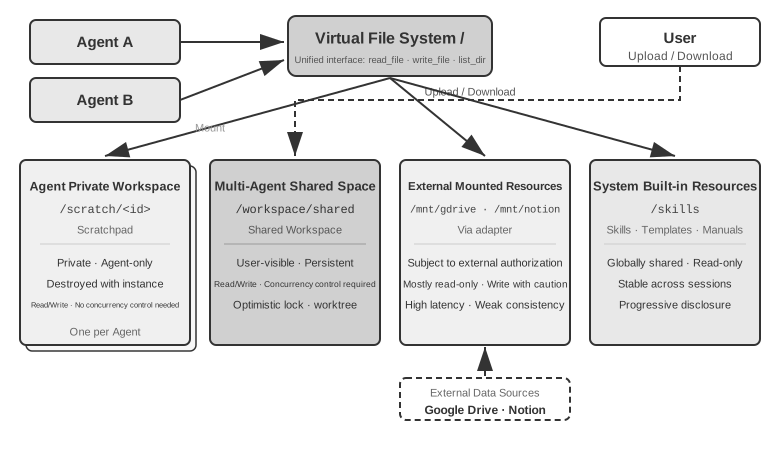
Data plane
Workspaces, shared artifacts, external and system mounts
Control plane
Spawn, message, status, terminate, and resource scheduling
Handoff package
Goal + evidence + artifacts + open questions + acceptance
---
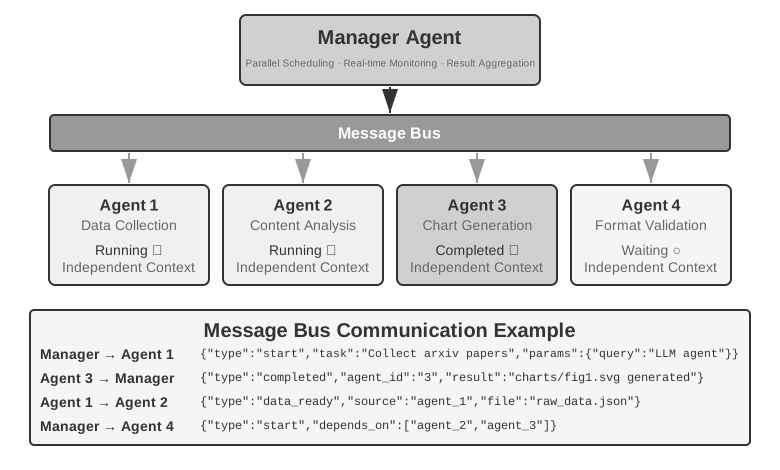
# The book's visual model

Manager architecture for sequential multi-Agent coordination
---
# Manager topology vs. Decentralized topology
Manager topology
- Global plan
- Simple supervision
- Planner is bottleneck
Decentralized topology
- Local ownership
- Flexible handoffs
- Harder global consistency
Topology determines where planning errors and coordination costs accumulate.
---
# Pass artifacts; observe lifecycle
~~~python
job = manager.spawn(role, goal, budget)
manager.message(job, evidence_paths)
while job.running: manager.observe(job.status)
result = manager.verify(job.artifacts)
manager.cancel_dependents_if_satisfied(result)
~~~
---
# Test the claim
10-32 min
Rehearse a four-role translation orchestration
Observe: Manager plan, glossary ownership, chapter budgets, proofreading, and integration
Demo budget: 2 minutes · one contiguous terminal block
---
class: course-terminal
---
Live demo
# Switching to the terminal
~~~bash
$ cd chapter10/book-translation && python demo.py --dry-run
~~~
Run the command(s), narrate decisions, and point to the observation—not just the output.
---
# What the evidence supports
Finding 1
Files handle large persistent artifacts; messages handle asynchronous coordination.
Finding 2
The manager's decomposition quality caps the value of stronger workers.
Finding 3
Explicit status and termination semantics matter as much as task prompts.
---
layout: center
---
Where the claim stops
# Boundary condition
A dry-run proves the orchestration graph and budgets—not translation quality or multi-Agent advantage.
---
layout: center
---
Engineering takeaway
# Design rule
Make ownership, artifact contracts, lifecycle states, budgets, and termination paths explicit before adding Agents.
---
# Continue the experiment
---
layout: center
class: text-center
---
Pause and apply
# Your turn
If the manager decomposes the task incorrectly, which independent gate can detect the mistake before workers waste their budgets?
---
layout: center
class: text-center
---
Next · Lesson 41
Test whether multiple Agents create new information or merely spend more tokens.
→