---
theme: seriph
title: "Lesson 41 — When Is Multi-Agent Actually Better Than One Agent?"
info: "English video course for AI Agents in Depth"
author: Bojie Li
transition: slide-left
mdc: true
lineNumbers: false
monaco: false
aspectRatio: 16/9
canvasWidth: 980
layout: cover
class: cover
---
Expand · Chapter 10 · Multi-Agent Collaboration
# When Is Multi-Agent Actually Better Than One Agent?
Information gain, parallelism, verification, budgets, and cost
Lesson 41 of 42 · 18 minutes · When Is Multi-Agent Truly Better; Parallel Coordination; Budget Awareness
---
layout: center
class: text-center
---
The central question
What does collaboration add that a single Agent with the same compute could not obtain?
---
# Why this problem matters
New evidence
Execution, rendering, browsing, and independent observations change the answer.
Parallel time
Independent searches reduce wall-clock latency when resources allow.
Cost
Multi-Agent systems may spend several times—or an order of magnitude—more tokens.
---
# Three ideas to keep in view
Information gain
The verifier observes something unavailable at generation time
Single settlement
One success can resolve the task and stop siblings
Budget awareness
Strategy changes with remaining steps and task value
---
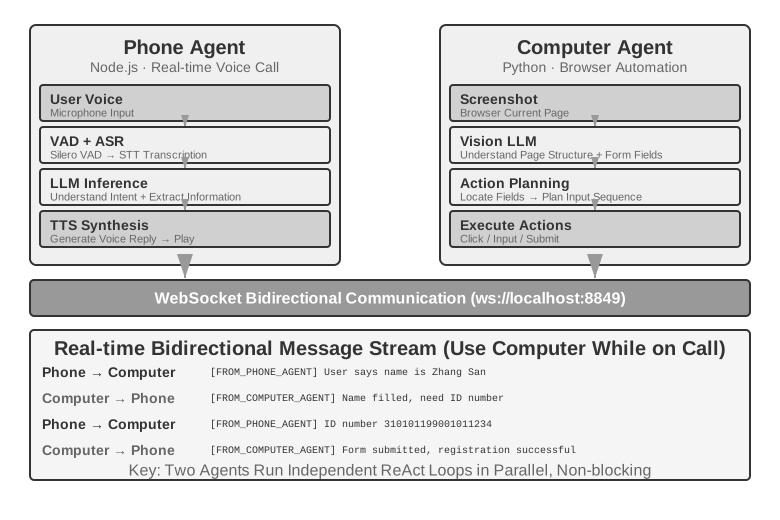
# The book's visual model

Parallel web research architecture
---
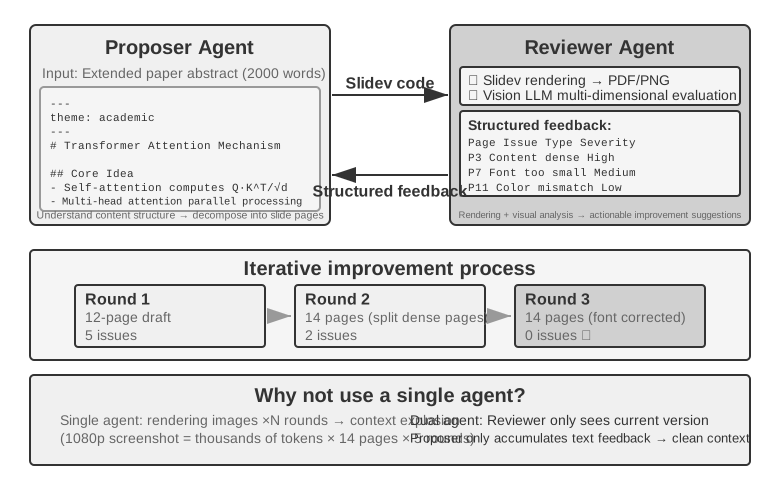
# More voices vs. More observations
More voices
- Same text
- Same evidence
- More samples and debate
More observations
- Independent tools
- Execution or visual feedback
- Parallel environment interaction
The advantage comes from information—not the number of Agent labels.
---
# Settle once; cancel the rest
~~~python
jobs = spawn_parallel(search_shards)
for result in as_completed(jobs):
evidence.merge(result.receipts)
if verifier.sufficient(evidence):
cancel_all(jobs); break
~~~
---
# Test the claim
10-63 min
Run parallel web research with independent browsers
Observe: Cited evidence, browser isolation, parallel speedup, timeout handling, and cleanup
Demo budget: 3 minutes · one contiguous terminal block
---
class: course-terminal
---
Live demo
# Switching to the terminal
~~~bash
$ cd chapter10/parallel-web-research && python demo.py
~~~
Run the command(s), narrate decisions, and point to the observation—not just the output.
---
# What the evidence supports
Finding 1
Debate over identical evidence often matches a single Agent at equal compute.
Finding 2
External feedback can nearly double performance because it adds observations.
Finding 3
Parallel speedup is real only when setup, contention, and cancellation costs are included.
---
layout: center
---
Where the claim stops
# Boundary condition
A speedup on one site and network condition does not prove lower total cost or better answer quality for every research task.
---
layout: center
---
Engineering takeaway
# Design rule
Add an Agent only when it owns a distinct observation, permission boundary, artifact, or parallelizable environment interaction.
---
# Continue the experiment
---
layout: center
class: text-center
---
Pause and apply
# Your turn
What new information does your proposed second Agent obtain that the first Agent cannot?
---
layout: center
class: text-center
---
Next · Lesson 42
Engineer against coordination failures—and examine what appears when Agent populations become societies.
→